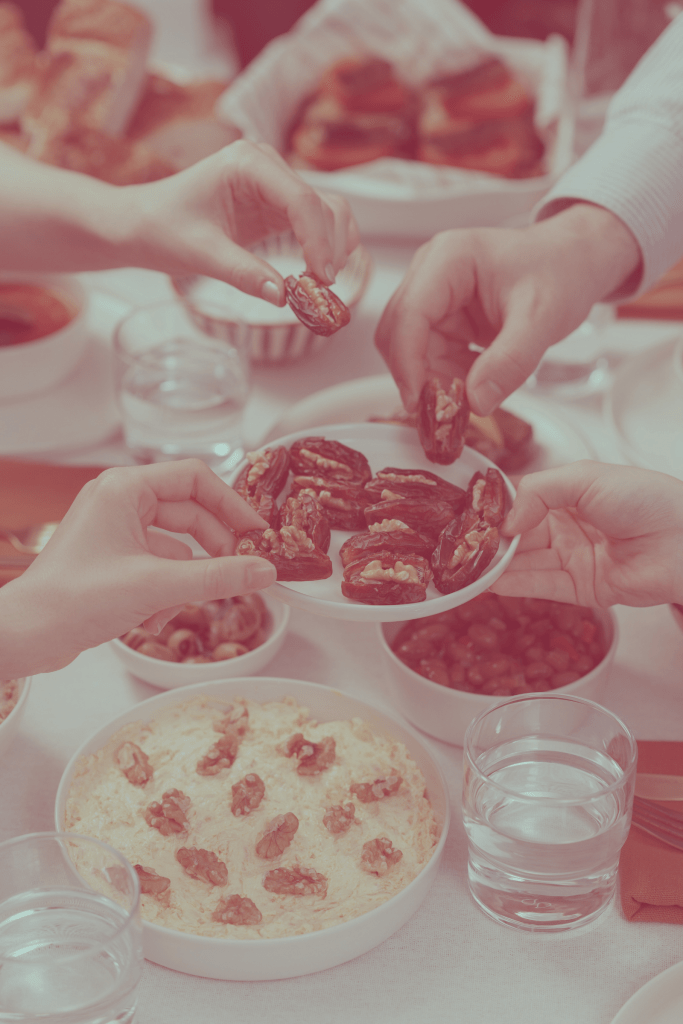
My husband comes from a large family of seven siblings, five of whom are married. This Eid saw a gathering of all but one of his brothers. His family doesn’t fit the rigid stereotypes often projected onto Muslim households. Yet, there would be times during family gatherings where I would find myself a lone woman among men. Unbeknownst to me, all the other women would find themselves gravitating towards the kitchen, aware that their presence in the kitchen was integral to the larger play we were all part of. A play where the curtains come down on Act 2 in the drawing room as the stage is set for Act 3 on the dining table. Occasionally, they would each come out and join the conversation, but only between chopping, stirring and frying. The cues of stage entry and exit were lost on me. How did they know?
As a 34-year-old woman who has lived by herself most of her adult life, the rhythms of mother-in-law’s—ammi’s—kitchen were alien to me, yet they were magnificent, almost poetic to watch. A practiced performance where each woman instinctively knew whether she should peel garlic, squeeze lemons for the rooh afza, fry pua, boil chana or do one of the twenty different tasks that happen in tandem to have iftari ready for 16 to 18 people.
Cooking made its way into my life because of absolute necessity. As a broke university student who couldn’t afford to dish out five pounds per meal or eat a Tesco sandwich with crisps and drink, I devised routines that kept me sane and gave me something to do whilst being stoned out of my mind The kitchen became a sanctuary, but I vowed to keep it basic: no fuss, no three-course meals. In fact, my motto was that I should be able to eat the dish out of the pan it’s been cooked in, just like my mother always cooked.
Of course, that was before I started paying attention to how alive the ingredients were. How salting onions too early can burn them; how mushrooms can become a watery mess. So, with the unhinged confidence of someone who not only lacks formal training but also the in situ wisdom that many absorb by watching their mothers in the kitchen, I decided to challenge my original motto. If need be, feeding myself should be a grand affair.
But there is cooking for joy, pleasure or necessity, and there is cooking as an expectation of being a woman, a married woman, or a woman who will be married. Until this Eid, I hadn’t ever felt or witnessed the burden of kitchen labour. There was no pressure on me to cook, yet being the only uninvolved daughter-in-law pricked at me. It put me in a state of being outside myself, an observer of me and all the women around me. Were they secretly experimenting with a recipe that’s set in stone, wondering what it would be like to add sliced garlic instead of the usual ginger-garlic paste? Why was no one humming, bursting into song or dance? I tried to make myself useful as and when I could, but my rhythms were totally alien.
Unlike ammi and my sisters-in-law, I hadn’t inherited recipes, movements, tools or other kitchen traditions. Theirs was a learnedness that I could never emulate—it was something that just happened by knowing, by having watched. Their movements were relaxed, timed and unfazed. A dance that they have danced many times, a dance that is somehow similar whether they interact with chickpeas or mutton or daal—assured and focused. There’s nary a reaction to the spluttering of cumin, no visible change in their expressions as a dish begins to come together, no moment of crisis when what they’re cooking looks nothing like the video or the recipe. It’s something they have witnessed all too often. The only excitement comes when at the table their food is praised, when it’s compared to the one true dish. I felt like I was the only one still trapped in Plato’s cave—left behind with mere shadows of understanding while everyone else had stepped into the light and tasted the real thing, the legendary Perfect Pyaazi which ammi fried circa 1999 (or was it 2001?).
As a child who grew up with neither of my grandmothers cooking for me, unaware of naani and daadi ke haath ka khaana, I felt I had been short-changed. Where were my roots? Why weren’t either of my grandmothers making vats of mango and chilli pickles and distributing them to everyone in the family? I think of my mother, a cigarette between her index and middle finger, while the remaining fingers are dedicated to Mario collecting mushrooms. Of how Nani and I spent more time chatting about how we prefer Thomas Hardy to Henry James, or our never-ending discussions about how dreamy Paul Newman was. If hard-pressed, I can remember only two set-in-stone recipes I can think of as my mother’s: Malka masoor daal which can only be tempered with cumin, tomatoes, ginger and green chillies, and oyster mushrooms (kiaon) with only cumin and chillies. But even though the tempering remains similar, the consistency of my mother’s malka ki daal is unacceptable to my Nani. And then there is my massi, who makes her versions of malka ki daal with mutton bones, a kind of invented stew that she survived on as a university student in Leiden.
Over the years, ammi and I have slowly opened up to one another. Like any two people with starkly different lived experiences, chatting and imagination has helped (ammi also makes vats of pickles to give to her daughters and daughters-in-law, perhaps the best mango pickle I’ve tasted). We try to figure each other out; she asks me how cooking is such a major part of my life, especially since my mother has told her how much she dislikes being in the kitchen. I ask about how she spent her time outside the kitchen or child-rearing as a young woman. She tells me about how she and her sisters-in-law sneakily listened to a radio, hiding it from her father-in-law. She describes the system they had so they would hide it as soon as he reached home. To me, her world is something set in sepia tones.
And that’s when it dawns on me, Ammi has probably never cooked for herself. Our ways to the kitchen have nothing in common, so how can our ways in the kitchen be congruent?
I can never share with ammi the full extent of my madness in the kitchen: how sea shanties or Run DMX are the best for chopping, how being stoned and listening to Misty Mountain Hop while wiping my kitchen down makes me feel like a barmaid who will be whisked away on a quest. Cooking, in my life, has been a rather imaginative affair, where I interact with the writer or creator of a recipe.
At home, I try to imitate their movements, my left hand resting on my lower back while the right casually stirs the pot. Before scooping a spoon of rajma to check if everything is alright, I remember the casualness of my sister-in-law, who hardly tastes what she is cooking but somehow always gets it right. I can’t help myself, I have to taste it; the ship of me imitating someone in the kitchen has sailed, and the rajma is watery and slightly salty. I console myself by adding curd to the rajma and call it madra which is how my mother prepared a version of Himachali madra during my childhood. Perhaps jugaad is what I inherited from her.
While the soup simmers in the pot, thoughts brew in Sasha Madan’s head, that too only when her ears aren’t hooked up to an audiobook. Occasionally, Sasha plops herself down to scribble these fleeting thoughts with a hope that they aren’t merely an assortment of ingredients but a new recipe that she has chanced upon, and very occasionally, she lucks out.
 Patina Magazine